
AI Technology in Service of Spiritual Awakening
Artificial Intelligence and 12-Step Recovery
“Upon therapy for the alcoholic (addict) themself, we surely have no monopoly.” (A.A. p xxi 4th Ed.)
AI must serve the human-to-human recovery relationship, never replace it.
The opportunity is not to create an artificial sponsor, an artificial fellowship, or an artificial Higher Power. It is to use a new technology to help people engage more deeply with the very human and spiritual process that makes 12-Step recovery distinctive.
It involves a transformation in consciousness, values, perception, and relationships that can change how a person responds to their desires. AI could assist that transformation without claiming to produce it.
Distinguishing the methodology from the technology
The 12-Step process has several interconnected dimensions.
The Human Recovery Relationship: One addict helping another through identification, shared experience, honesty, and service.
The 12-Step Methodology
Self-examination, surrender, moral inventory, confession, amends, prayer, meditation, and service.Transformation of Consciousness
Greater self-awareness, humility, acceptance, responsibility, and spiritual experience.A Changed Relationship With Addiction
Greater freedom from compulsive behaviour and a life increasingly directed by spiritual principles
This is a description of the intended spiritual process, not a guarantee that every participant will experience the same transformation.
AI can support several stages of this journey. But it cannot establish that a spiritual awakening has occurred, substitute for lived experience, or assume the moral responsibility of another human being.
Seven ways AI could strengthen 12-Step recovery
1. A mirror for self-examination
AI can help a person identify recurring patterns of fear, resentment, dishonesty, avoidance, rationalization, and self-centredness. It can ask reflective questions without pretending to know the person’s inner motives.
Example: “What were you afraid of losing in this situation? How might that fear have influenced your actions?”
2. Better preparation for sponsorship
AI could help a newcomer organize their thoughts, prepare questions, and articulate difficult feelings before speaking with a sponsor. It prepares the conversation; it does not conduct the sponsorship relationship.
3. Removing barriers to fellowship
AI-assisted translation, accessible reading formats, meeting discovery, and plain-language explanations can help people participate across differences in language, geography, literacy, and disability. This is especially relevant to online recovery communities.
4. Encouraging conscious reflection
AI can provide journaling prompts and questions about values, intention, gratitude, prayer, and meditation. It can support the practice of reflection without claiming to reveal the will of a Higher Power.
5. Recognizing behavioural patterns
AI could help someone examine the sequence of events preceding compulsive behaviour: emotional discomfort, obsessive thinking, rationalization, isolation, and acting out. Recognizing a pattern creates an opportunity to discuss it with another recovering person and choose a different response.
6. Making recovery literature more accessible
AI can explain unfamiliar vocabulary, compare interpretations, generate study questions, and help people engage with historical recovery literature. Its explanations should be checked against each respective 12 Step approved source material and not presented as official fellowship doctrine.
7. Supporting service to others
AI can assist with meeting accessibility, service manuals, communications, outreach materials, and administrative work. The result can be more time for actual human connection, sponsorship, and carrying the message.
The most important distinction: AI can stimulate reflection, but cannot confer spiritual experience
Twelve-Step fellowships include members with theistic, non-theistic, psychological, and other spiritual understandings. AI need not resolve that question. Instead, it can support the conditions in which a person explores their own spiritual understanding.
For example, consider a member struggling with resentment.
MEMBER: “I’m furious with another member. I keep replaying what happened, and I want to get even.”
AI REFLECTION TOOL: “What do you think was threatened: your security, self-esteem, relationships, or sense of fairness? Is there anything you want to discuss with your sponsor before acting?”
HUMAN SPONSORSHIP: The member brings those reflections to another recovering person, where lived experience, identification, accountability, and compassion can deepen the examination. AI has not resolved the resentment. It has helped prepare the member to examine it more consciously.
The distinction is essential: information can be generated by a machine; lived transformation belongs to the human being.
Guidelines for protecting the human-to-human equation
The greatest danger may not be that AI gives incorrect information. It may be that a person gradually substitutes interaction with a machine for the vulnerability, accountability, and fellowship involved in recovery.
Here are some suggested guidelines:
- AI is a tool, never a sponsor. It cannot claim personal recovery experience or substitute for human identification.
- AI is not a Higher Power. It may help someone reflect on spiritual principles, but should never claim divine or spiritual authority.
- AI encourages human contact. When appropriate, it should help members prepare to speak with sponsors, trusted fellows, or qualified professionals.
- AI respects anonymity and confidentiality. Members should avoid entering identifiable inventories, other people’s stories, or sensitive meeting information into services without understanding their privacy practices.
- AI does not dictate moral conclusions. It can ask questions and offer perspectives; the member remains responsible for conscience and action.
- AI recognizes its limitations. It must not act as a substitute for emergency support, withdrawal management, addiction treatment, or mental-health care.
- AI remains accountable to human judgment. Any fellowship-sponsored use should have transparent, reviewable guidelines, including clear distinctions between official literature and AI-generated interpretations.
Research has identified inaccurate responses and failures to recognize crises as significant limitations of AI mental-health systems. These are practical reasons to take such guidelines seriously.
The Human-Centred AI Recovery Companion
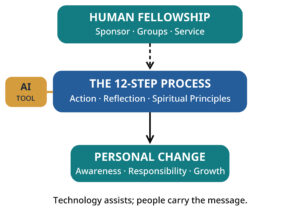
The AI 12 Step Recovery Tool could have three distinct functions.
- Before human contact: Help members prepare inventories, identify questions, understand literature, and locate meetings.
- Between human contacts: Offer reflection prompts, help organize observations about behaviour, and encourage timely outreach when difficulties arise.
- After human contact: Help members reflect on what they learned, organize commitments they freely chose, and prepare for their next conversation.
This structure makes AI a bridge between recovery activities rather than a destination in itself.
Lastly, the Twelve Steps offer a methodology of personal transformation grounded in spiritual principles, moral responsibility, and one suffering human being helping another. Artificial intelligence does not possess lived recovery experience, cannot become a sponsor, and cannot replace the spiritual relationship between human beings. But it can help people ask better questions, examine their thinking, understand recovery literature, overcome barriers to participation, and prepare for meaningful conversations with others.
Properly guided, AI could make recovery resources more accessible without compromising the human relationships at the heart of the Fellowship.
The measure of successful AI integration should not be how attached a recovering person becomes to the technology, but how effectively that technology helps the person reconnect with themselves, their spiritual understanding, and other human beings.